
CC Letters: Issue No. 41
RE: Code Enforcement Positions, JSKT Land Transfer Act, Peninsula College Workforce, Public Comment Process, Proposed Bail Reform

Mission Statement: To preserve and publish citizen correspondence with local government as a public record of civic participation.
to: ”Gores, Loni” <loni.gores@clallamcountywa.gov>, “Emery, Bruce” <Bruce.Emery@clallamcountywa.gov>
cc: ”King, Brian” <brian.king@clallamcountywa.gov>, allison.berry@clallamcountywa.gov
bcc: clallamityjen@gmail.com
date: Apr 21, 2026, 11:09 AM subject: Citizan Letter of Support for Additional Clallam County Code Enforcement FTE Positions
Hi Loni,
Please share my correspondence with the Commissioners. Thank you.
Dear Clallam County Commissioners and Mr. Emery,
I am writing to formally express my support for the addition of two full-time equivalent (FTE) positions within Clallam County Code Enforcement.
Recent developments concerning the property at 6992 Old Olympic Highway—noted for its association with federal mail crimes and nearly a decade of environmental hazards—highlight the urgent need for increased enforcement capacity. This situation reflects a broader pattern of delayed enforcement and limited staffing that negatively impacts public health, safety, and environmental quality.
Adding two dedicated FTEs would offer significant benefits, including:
- Expedited response times to complaints and violations.
- Improved oversight of chronic nuisance properties.
- Reduced long-term remediation costs through early intervention.
- Stronger deterrence against repeat violations.
- Enhanced coordination with law enforcement and public health agencies.
Furthermore, it is imperative that Code Enforcement collaborates with the Department of Health and the Sheriff’s Office to address toxic hazards in the Tumwater and Peabody watersheds. The accumulation of waste in these areas is actively damaging our water supply and local habitats, requiring immediate action.
Code enforcement is a vital function that protects our community and preserves property values. I urge you to prioritize and approve these additional positions to ensure Clallam County can address these issues proactively.
Thank you for your time and consideration.
Sincerely,
[Redacted]
Date: Wed, Apr 8, 2026 at 8:02 AM Subject: JSKT Land Transfer Act 2026
To: <Mark.Ozias@clallamcountywa.gov>, <Randy.Johnson@clallamcountywa.gov>, <Mike.French@clallamcountywa.gov>, <loni.gores@clallamcountywa.gov>
As tax paying residents of Clallam County, Washington, we write to express our opposition to “The Jamestown S’Klallam Tribe Land Transfer Act of 2026,” legislation that would transfer former National Wildlife Refuge lands, comprising the Dungeness and Protection Island National Wildlife Refuges, from federal stewardship to the Bureau of Indian Affairs to be held in trust for the Jamestown S’Klallam Tribe.
Clallam County has long appreciated its cooperative relationship with the Jamestown S’Klallam Tribe, particularly through collaborative efforts on watershed management and salmon recovery. However, we have serious concerns about this proposed land transfer, which would fundamentally alter the ownership, management framework, and public oversight of these federally protected lands.
The Dungeness and Protection Island National Wildlife Refuges have been managed for decades for the benefit of the public as part of the U.S. Fish and Wildlife Service’s National Wildlife Refuge System. These areas support critical wildlife habitat, public recreation, education, and scientific research. Transferring these lands from the Refuge System to a trust status under the Bureau of Indian Affairs risks creating inconsistent management practices, reduced public accountability, and potential limits on public access. We feel
continued federal management best ensures the transparent, science-based, and conservation-oriented oversight that has long protected these unique habitats.
Additionally, the Refuge lands in question serve a broad constituency extending far beyond Clallam County and the Jamestown S’Klallam Tribe. They are visited by thousands of people annually, contributing to regional tourism and sustaining businesses in the greater Olympic Peninsula. Transitioning these lands into Tribal trust could create uncertainty regarding future access, tourism activity, and the continuity of existing conservation programs, which may impact both residents and local economies.While we understand Tribal sovereignty and recognize the Tribe’s role as a local partner in natural resource
management, we must express concern regarding the precedent such a transfer would establish. Turning over federal refuge lands—designated for national conservation purposes—to a non-federal entity, even under trust status, will invite similar proposals elsewhere, undermining the integrity of the National Wildlife Refuge System as a whole.
We further emphasize that while proponents assert that the transfer will not change existing land uses, such assurances are not permanently binding and could be revisited through future administrative or legal actions. Federal ownership provides the highest level of long-term protection, consistent public engagement, and accountability to taxpayers. (i.e. Towne Hall Rd debacle)
For these reasons, we respectfully urge the delegation to oppose “The Jamestown S’Klallam Tribe Land Transfer Act of 2026” and instead support continued collaboration among the Jamestown S’Klallam Tribe, the U.S. Fish and Wildlife Service, and Clallam County through existing cooperative agreements. These partnerships offer a proven, balanced approach that preserves both Tribal involvement and federal stewardship to ensure conservation, transparency, and public access in perpetuity.
Sincerely,
[Redacted]
to: sames@pencol.edu cc: [Redacted] bcc:clallamityjen@gmail.com
date: Apr 25, 2026, 8:35 PM subject: Request for Fiscal Priorities and Peninsula College Workforce Program Protection
Dear Dr. Suzanne Ames:
I am writing to express serious concern regarding Peninsula College’s current financial situation and the difficult decisions now facing the college that opened in 1961. Given the recent article in the Peninsula Daily News about the $1.8 million dollar financial budget shortfall, I urge leadership to prioritize actions that protect the long-term economic viability of both the college and the community it serves.
First, I strongly advocate for the preservation—and if possible, expansion—of all trades and workforce education programs. These programs are not optional; they are essential. They directly support regional labor markets, provide family-wage career pathways, and serve students who rely on practical, job-ready skills. Cutting or weakening these programs would have immediate and lasting negative impacts on Clallam and Jefferson County economies.
Conversely, I ask that leadership conduct a transparent and rigorous review of non-essential or low-enrollment academic offerings. In times of financial constraint, difficult prioritization is necessary. Resources should be aligned with programs that deliver measurable workforce outcomes and community benefit.
Second, I request clarity on administrative cost controls. Specifically:
- Are leadership and executive salaries being evaluated for temporary reduction or restructuring during this financial crisis?
- What shared sacrifices are being made at the administrative level to preserve instructional capacity?
Third, I encourage the college to aggressively pursue external funding partnerships. Has Peninsula College explored collaboration with the Jamestown S’Klallam Tribe to pursue federal and Washington State Commerce grants aimed at workforce development and trades education? Tribal partnerships and grant alignment could represent a meaningful funding stream that directly supports the programs most critical to regional stability.
Finally, I ask for a clear and transparent plan addressing the central question: What is the strategy to keep the college operational and sustainable long-term? The community deserves to understand not only the immediate cuts, but the forward-looking plan to stabilize enrollment, rebuild revenue, and restore confidence.
We live in a modern, highly competitive economy where access to relevant education is essential. Many in the community are asking how leadership decisions have contributed to the current position and what accountability measures are in place moving forward. More importantly, we want to know how the college will ensure it does not fail the next generation of students who depend on it.
I respectfully request a response addressing these concerns and outlining the steps being taken to protect Peninsula College’s mission and future.
Sincerely,
[Redacted]
— — —
On Sun, Apr 26, 2026, 4:42 PM Suzy Ames <SAmes@pencol.edu> wrote:
Hello [Redacted],
Thank you so very much for your thoughtful questions and for giving me an opportunity to share some information. And, thank you for caring for Peninsula College. I, too, care deeply for PC. I’ve wanted to be president of PC for more than ten years prior to successfully earning the position in July 2022. My husband and I hope to retire here, and spend our final years being continually proud of our local gem of a community college.
Since you asked, I’d like to provide some historical context, reasons for recent decisions, and my plans for the college’s future.
First, some history… You may not know, PC was in a very precarious financial situation when I arrived in July 2022. We were experiencing a steady 10-year enrollment decline, many instructional programs were out of date and not in alignment with workforce needs, new workforce programs had not been started in many years, and we had a $1 million budget deficit. The financial situation would have been worse if the federal Covid relief dollars hadn’t carried the college for a few of those years.
Prior to coming to PC, I was an instructional administrator for seven years at a technical college. I am a huge believer in workforce education and the trades. When I arrived at PC, I met with numerous employers and community leaders to assess the workforce education needs. The list of needs was long. The amazing team of college employees heeded my call and responded by starting 11 new workforce education programs in just one year. To say this was a massive undertaking is a huge understatement. Most colleges might start one or two programs in a year, never anything close to 11. Since then, we’ve added another one, a new one coming online this fall, and more in the works. As a result, PC had the fastest growth in enrollment in the state two years in a row. Due to decisions made by the Legislature (described in the next paragraph), PC actually received less state funding per student those two years when our enrollment was soaring. This year, enrollment unexpectedly dipped lower than our budget projections – mostly in our workforce programs. There are several reasons for this dip, but the primary one is a challenging economy where students are having to choose between going to college or getting a second job so they can afford groceries and gas. Financial aid covers a lot, but not all living expenses when inflation is soaring.
So, how did PC get into this budget shortfall? At the state level, it started about 10 years ago with several legislative policies that have resulted in a slow erosion of state funding for all of Washington’s community colleges. None of these state cuts were big enough to capture headlines at the time, but the cumulative effect is preventing community colleges from being able to cover inflation-driven costs. Two examples of state policy decisions include: a freezing of tuition since 2015, preventing it from keeping pace with inflation, and not back-filling the cost; and not fully funding mandatory cost of living increases and requiring colleges to make up the difference. All 34 community and technical colleges across the state are reeling from these and other decisions in Olympia. If you have an opportunity to talk with legislators, your advocacy for adequate funding for community colleges would be much appreciated.
Last year, we eliminated 16 staff (non-faculty) positions. There were no cuts to instruction last year, as we know it is core to our operations. More staff positions will be eliminated this year too. In addition, all staff employees (non-faculty) earning more than $90,000 will take 12 unpaid furlough days next school year. I am the lowest paid community college president in the state because the college’s budget constraints have not allowed my salary to remain at the same level as my peers at other rural community colleges. I have regularly asked the Board of Trustees (my bosses) to not give me a raise due to our budget challenges.
While PC is adjusting to the erosion of state funding and developing efficient budgets, we are also making necessary investments to start new workforce education programs directly tied to local jobs. We are cutting in non-essential areas and growing in strategic areas that create livable wage jobs for our community.
I appreciate your recommendation for a transparent and rigorous review of non-essential or low-enrollment academic offerings. That is exactly what we are doing. To achieve the highest degree of long-term fiscal sustainability, the college is bringing its instructional budget in line with state funding. This is a change that is a longtime coming. Targeted class cuts are being made that still allow students to meet their degree requirements, but fewer options will be available. Instructional administrators are working with faculty in every discipline to determine the most essential classes. A class with low enrollment will no longer be offered unless it is the only option for a student to graduate on time. These changes will create a leaner, sustainable college for the future.
As you know from the PDN article, there is currently a list of five workforce programs that are being considered for closure or pausing. No final decisions have been made. I am working collaboratively with our faculty union to develop creative solutions to keep some of these programs continuing. These workforce programs were rated by an objective team of faculty who assessed the program enrollment, the relevancy of the curriculum to the local workforce, quality of the curriculum and more. Through this rating process, the Construction Trades ranked the highest of the five programs tentatively slated for a pause or elimination. I am working hard with my team to find a way to save the Construction Trades program, in particular, due its higher PC rating and my personal knowledge of the good jobs our graduates earn.
To your point regarding external partnerships: Yes, under my leadership, PC has formed numerous partnerships that have brought in significant funding for PC. It is one of the aspects of my leadership I am most proud of. Here are a few examples, but there are too many to list here. The Jamestown S’Klallam Tribe is giving PC $75,000 toward the start-up of our Dental Hygiene program. Senator Murray secured $1.96 million for this endeavor as well. Through a partnership with both counties, all three economic development councils, non-profit organizations and others, we secured $45 million from the federal Economic Development Agency to foster regional economic growth. PC’s share of that is $6 million. With PC’s funding, we are purchasing mobile training units so we can travel to the rural areas of Clallam and Jefferson county bringing welding and marine manufacturing training to the community. In working with local non-profits and K-12 leaders, I helped secure a four-year Gates Foundation Grant to bring high school juniors and seniors across our region to college campuses and employer sites to learn about opportunities and pathways to success after high school. I also led a partnership with local leaders to secure a grant from the Washington State Achievement Council to bring more services and outreach efforts to low-income adults in our community who need assistance getting on a path to college.
As for the long-term plan, Peninsula College is doing everything possible to achieve sustainable efficiency. I am really proud of our efforts thus far, and we are not done. At the same time, the Legislature must work together with us to stop the decade-long erosion of public support. Community members need to be vocal with their lawmakers that community colleges are essential to a thriving state. I will gladly join you in those conversations if you would like.
I hope this information has been helpful to give a broader explanation of how we got here and the steps we are taking to becoming stable for the future. Please feel free to share this information with others.
Suzy
Suzy Ames, Ed. D. (She/Her)
President
Peninsula College
sames@pencol.edu
360-417-6200
— — —
to: Suzy Ames <SAmes@pencol.edu> cc: [Redacted]
bcc: clallamityjen@gmail.com date: Apr 27, 2026, 8:16 PM
subject: Re: Request for Fiscal Priorities and Peninsula College Workforce Program Protection
Dear Dr. Ames,
Thank you for your detailed and heartfelt response. I truly appreciate the historical context you provided regarding Peninsula College’s financial position, as well as your personal commitment to the institution’s future.
As a strong advocate for higher education with family roots in academic administration, I feel a deep connection to the trades. My late grandfather, a WWII Army veteran and self-taught welder, was instrumental in establishing the first boat-building program at Seattle Community College in the 1970s. His legacy continues to inform my belief that these programs are vital to our community's economic and social health.
Regarding the college's financial strategy and enrollment, I have the following questions and observations:
To what extent do incoming Peninsula College students utilize the Washington College Grant, and is there a strategy to increase its adoption to mitigate the enrollment dip you mentioned?
I strongly urge the college to prioritize the preservation of trades programs. In reviewing the current curriculum, I suggest considering reductions in liberal arts and elective offerings—such as zoology, foreign languages, physical education, drama, film, first aid, and psychology—to protect essential workforce training. Additionally, I would appreciate clarification on the "Washington Association for Community" listing found in the course catalog.
Given the rapid integration of Artificial Intelligence across all industries, how is Peninsula College currently embracing and incorporating AI into its curriculum and daily operations?
Furthermore, does Peninsula College have any accreditation or partnerships with the University of Washington or Washington State University to offer four-year degrees in Nursing and Business locally?
Thank you for your time and for the work you are doing to navigate these challenging fiscal circumstances. I look forward to hearing your thoughts on these matters.
Respectfully,
[Redacted]
[This is a response to an email published in Issue No. 40]
On Wed, Apr 29, 2026 at 11:20 AM Johnson, Randy <randy.johnson@clallamcountywa.gov> wrote:
Thank you for your comments.
This has always been a difficult issue for the public and for that matter, the commissioners. There is so much legislation that is put forward during the legislative season, it is hard to track. Mike French is the County’s legislative liaison to the Washington Counties who have lobbyists on the many issues including roads, health care, etc. but it is impossible to keep up with all the proposed bills during the session. Clallam County also weighs in their legislative priorities through our Legislative Alliance for legislation we think is important specifically to our county. During session, we also provide opposition to the legislation that will negatively affect our county, but many times this legislation passes regardless of our input. Remember, we are a rural county, and our voice is often not heard.
Therefore, the question becomes how the Clallam County become more effective. Issues like affordable housing continues to bother me when there are regulations promulgated by the building council, legislature and governor in the name of environmental stewardship but have little real benefit. These regulations add $100k to a house which then makes homes unaffordable, and the commissioners are criticized for a $350k/unit building cost.
Your ideas about how to inform the public would be appreciated.
Randy
— — —
to: ”Johnson, Randy” <randy.johnson@clallamcountywa.gov>
bcc: clallamityjen@gmail.com date: May 7, 2026, 1:37 PM
subject:Re: Follow-up on public comment process and state legislation awareness
Dear Commissioner Johnson,
Thank you for your thoughtful response and additional context about how the County engages during the legislative session. I now better appreciate the challenges involved in tracking so many bills and advocating effectively as a rural county whose concerns are not always prioritized at the state level.
I also appreciate your acknowledgment that this is a difficult issue for both the public and the commissioners. Many residents want to stay informed and engaged but do not always know where to focus their attention while legislation is still being debated.
Since you asked for ideas, I think even a few modest communication improvements could make a meaningful difference:
Updating the Commissioners’ section of the County website with current information and making it easier to navigate.
Creating a simple “Legislative Watch” or “Calls to Action” page listing bills the County is monitoring, along with brief summaries of local impacts and information on how residents can formally support or oppose proposals.
Including links to that page in weekly agendas and meeting minutes.
Sending an email or snail mail newsletter once or twice during the legislative session highlighting issues affecting Clallam County.
Many residents may not be comfortable navigating government websites or tracking legislation independently, but they would likely participate if they knew where to direct their efforts.
We want to help support the County’s priorities. Providing clearer direction on where residents can focus their energy would allow more people to engage constructively and help spread the word.
I also wanted to respond to your comment regarding criticism of the approximately $350,000 per-unit cost of permanent supportive housing projects. Speaking for myself, I am concerned not only about the upfront construction cost, but also the ongoing operational and monitoring expenses that will continue to be funded by taxpayers, whether indirectly through grants or more directly through property, sales, and other taxes.
In my own case, I spent more than 30 years scrimping and saving to pay off my home, yet I still pay nearly $13,000 annually in property taxes and insurance just to remain in my home, not including utilities or regular maintenance. Based on those costs alone, retirement is becoming increasingly difficult to envision. Given that reality, I hope you can understand why I struggle to support low-barrier permanent supportive housing projects that appear to include high-end amenities such as water views and rooftop terraces while offering little visible accountability or expectations tied to long-term independence.
I recognize these are difficult and complicated issues, and I do appreciate the County trying to navigate them within the constraints imposed by state policies and funding requirements.
Thank you again for the conversation and for your willingness to engage on these topics.
Kind regards,
[Redacted]
to: ”Gores, Loni” <loni.gores@clallamcountywa.gov> cc: ”Talebi, Bobbak (ECY)” <BTAL461@ecy.wa.gov>, “Fleskes, Robin (ECY)” <rojo461@ecy.wa.gov>,
Kenny.Ocker@dnr.wa.gov, april.messenger@mail.house.gov,
“Mielke, Todd” <Todd.Mielke@clallamcountywa.gov>
bcc: clallamityjen@gmail.com date: Apr 13, 2026, 4:01 PM
subject:Will I be considered a visitor within my own county?
Hi Loni,
I hope your Monday is going well.
Please forward the following correspondence to the Commissioners regarding the Jamestown S'Klallam Tribe Land Transfer Act of 2026.
Dear Commissioners,
I am writing to formally express my strong opposition to the Jamestown S'Klallam Tribe Land Transfer Act of 2026. After attending the regular Commissioners work session meeting today, April 13, 2026, and hearing the presentation by tribal representatives, I am concerned that the proposed land transfer is based primarily on ancestral claims rather than a demonstrated functional need for 200 tribal members.
I believe that ancestral history alone does not substantiate the request to transfer ownership of these American territories, specifically the 700-acre Dungeness Wildlife Refuge and the 300-acre Protection Island Refuge. Our shared freedoms were secured through the service and sacrifice of many, including members of my own family, and I believe these public lands should remain under federal jurisdiction. Furthermore, the Tribe continues to benefit from taxpayer-funded infrastructure and services—including roads, utilities, schools, healthcare, and public safety—while non-tribal citizens do not have reciprocal access to tribal commerce and lands.
Additionally, as a frequent visitor to the Dungeness Wildlife Refuge, my observations differ significantly from the points articulated in today’s presentation. I have noted that visitors frequently disregard the posted $3.00 entrance fee and that the new restroom facilities were funded by American taxpayers. The presentation also failed to acknowledge the significant contributions of U.S. Fish & Wildlife personnel and volunteers who have managed the refuges successfully. The presenters emphasized that they are better land stewards than than U.S. government employees, which raises concerns regarding the basis of such claims.
In light of the presentation, I would like to pose the following questions for your consideration:
- Will you be inviting the U.S. Fish & Wildlife employees who were displaced from their jobs to provide a critique or review of the Tribe’s two-year contract?
- Will the management contract be open for competitive bidding from other contractors when the Tribe's current term expires in August 2026?
- What is the justification for supporting an enterprise that replaces educated American workers in these paying positions?
Furthermore, the Tribe’s current commercial ventures—including a 122-acre golf course, a five-star hotel, modern casino, Marijuana Dispensary, fueling center, and seasonal light displays reportedly costing over $500,000—stand in stark contrast to the environmental and ancestral arguments presented. Such practices do not appear to align with conservation or ecological efforts and suggest that funds could be redirected more effectively toward local grassroots nonprofits.
Finally, I am concerned by the proposed "pop-up" events and other non-essential activities at the Dungeness Wildlife Refuge. A refuge should be a secure, remote location and a place of peace, rather than a venue for commercialized events.
I urge you to withhold support for the Jamestown S'Klallam Tribe Land Transfer Act of 2026 and ensure these lands remain public for the benefit of future American generations.
Sincerely,
[Redacted]
to: ”Nichols, Mark” <mark.nichols@clallamcountywa.gov>
cc: sheriff@co.clallam.wa.us, [Redacted] bcc: clallamityjen@gmail.com
date: May 1, 2026, 7:55 AM subject: Do you support the proposed bail reform?
Good morning Mr. Nichols,
Sheriff King has publicly expressed his opposition to the proposed bail reforms, a position with which I concur. Could you please confirm your stance on this matter?
Additionally, Port of Port Angeles Commissioner Steve Burke has resigned following pressure from the residing Port of Port Angeles Commissioners. While I understand this case does not fall directly under your purview, I inquire whether it would be feasible to engage an independent attorney to oversee this investigation. As a taxpayer in Clallam County, a region with limited financial resources, and a supporter of the aquatic center, I am keen to see the recovery of any misappropriated funds and that Burke be prosecuted.
As an elected prosecutor, your constituents rely on your office to pursue cases that impact the county’s fiscal health. What measures do you intend to implement to exert control over such matters?
Furthermore, what is your position on tribal law? Specifically, do you support the Jamestown S’Klallam Tribe Land Transfer Act of 2026? I personally oppose this transfer due to concerns regarding potential loss of public access and the validity of my federal park pass. It is important to acknowledge that, despite statements from Loni Greninger, Vice Chair of the Jamestown S’Klallam Tribe, the tribe operates as a sovereign nation.
I welcome any feedback you can provide regarding these inquiries. I also encourage your office to leverage social media to communicate both successes and challenges, similar to the commendable efforts of Sheriff King in keeping our community informed.
Thank you,
[Redacted]
— — —
From: Nichols, Mark <mark.nichols@clallamcountywa.gov>
Date: Fri, May 1, 2026, 9:33 AM
Subject: RE: Do you support the proposed bail reform?
To: [Redacted] Cc: sheriff@co.clallam.wa.us <sheriff@co.clallam.wa.us>
[Redacted]:
Thank you for your email.
In response to your first question, I strongly oppose the suggested amendments to criminal rules 2.2 and 3.2 which, if adopted, would reform current bail practices in a way that I believe would further undermine public safety. I have attached a copy of the Washington Association of Prosecuting Attorney’s (WAPA) comment letter to the Washington Supreme Court. [Link] This letter explains the substantive and procedural reasons for which prosecutors from around the state collectively oppose the proposed amendments.
In response to your second question, I have already engaged an independent attorney (by and through the Washington Attorney General’s Office or AGO) to review the Washington State Auditor’s fraud referral involving the Shore Aquatic Center. The AGO will work with the SAO in relation to any additional investigation and decide whether to file charges in the matter.
In response to your third question, I have a working knowledge of tribal law having dealt with a variety of tribal law issues over the course of the last 20+ years. Land transfers fall within the province of the legislative branch of county government and are not a prosecutor matter. (The county prosecutor’s duties are set forth in RCW 36.27.020, the full text of which may be viewed here: https://app.leg.wa.gov/rcw/default.aspx?cite=36.27.020.) For this reason, and out of respect for the role of the prosecutor vis – a – vis that of the county legislative authority within county government, I am respectfully declining to answer your question regarding my personal stance on land transfers.
Best,
Mark Nichols
Clallam County Prosecuting Attorney
WAPA Vice President
— — —
to: ”Nichols, Mark” <mark.nichols@clallamcountywa.gov>
cc: [Redacted] bcc: clallamityjen@gmail.com
date: May 1, 2026, 12:46 PM subject: Re: Do you support the proposed bail reform?
Dear Mr. Nichols,
Thank you for your email and for providing the WAPA comment letter concerning the proposed bail reforms. Your engagement is highly valued and appreciated.
In light of your position as Vice President and your influence within the Washington Association of Prosecuting Attorneys (WAPA) are you planning to submit your own recommendations to the independent AG’s office attorney on the Steve Burke Fraud case? Given the AG’s Office’s significant caseload of fraud cases, many of which are more substantial than Mr. Steve Burke’s, who will be responsible for communicating with the community regarding fund recovery and prosecution? Could you please provide the relevant case number? Can the public send letters to the AG’s attorney?
Concerning tribal matters, I understand that the Jefferson County Commissioners recently acknowledged the Jamestown S’Klallam Tribe Land Transfer Act of 2026, anticipating a projected loss of $26,000 in yearly county revenue. Have you designated an independent attorney to handle any tribal correspondence in collaboration with the Clallam County Commissioners? Furthermore, will this independent attorney assess any potential revenue loss to our county budget stemming from this proposed transfer?
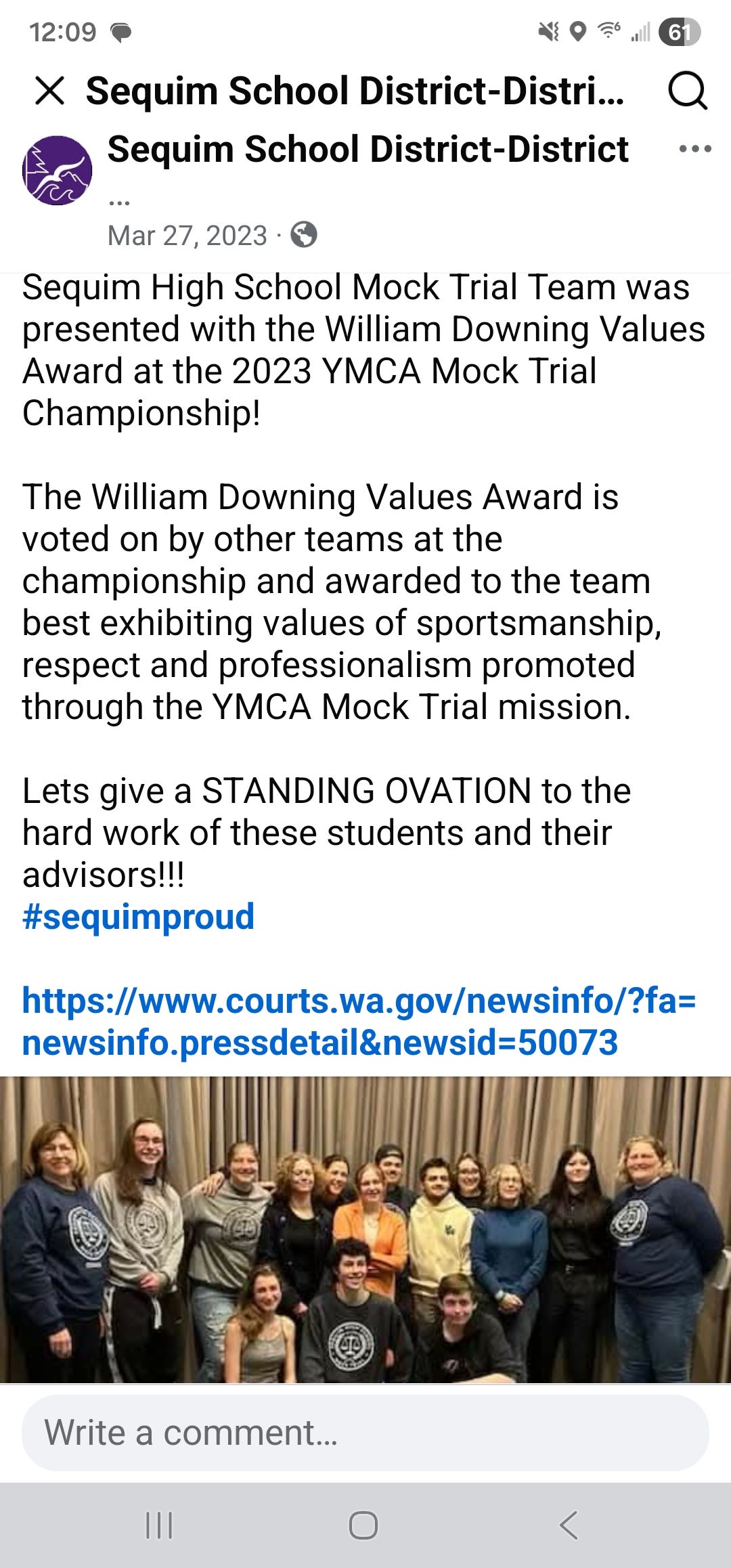
Lastly, do you mentor any mock trial teams at Sequim or Port Angeles high schools?
Thank you,
[Redacted]
— — —
On Fri, May 1, 2026, 3:32 PM Nichols, Mark <mark.nichols@clallamcountywa.gov> wrote:
Hello [Redacted].
Thank you for your reply email.
In response to your first point, given the existence of a conflict of interest (which involves the fact that two of three members of the Clallam County Board of County Commissioners simultaneously serve on the board for the Shore Aquatic Center), I cannot ethically be involved in the matter involving the Shore Aquatic Center. This is because the prosecutor represents the county under state law. It is for this reason that I outsourced this matter to the AGO and have maintained an arm’s length distance. You are free to inquire with the AGO regarding the status of the matter.
In response to your second point, I have not designated an independent attorney to handle any tribal correspondence in collaboration with the Clallam County Commissioners.
In response to your third point, one or more of my deputies has over the course of time helped to instruct local mock trial exercises.
Best,
Mark Nichols
Clallam County Prosecuting Attorney
— — —
to: ”Nichols, Mark” <mark.nichols@clallamcountywa.gov>
bcc: clallamityjen@gmail.com date: May 1, 2026, 4:04 PM
subject: Re: Do you support the proposed bail reform?
Dear Mr. Nichols,
Regarding your previous correspondence, if Commissioners French and Johnson were to resign from the William Shore Aquatic Pool advisory board, would an independent attorney retained by Clallam County still encounter a conflict of interest in pursuing fund collections and prosecution?
I am seeking clarification on your stated conflict of interest as our elected county prosecutor. Are you indicating that the Commissioners dictate which cases you are able to prosecute?
Sincerely,
[Redacted]
Next Issue: Thursday, May 14, 2026
ANNOUNCEMENTS:
🇺🇸 Response from the U.S. Department of the Interior:
From Clallam Freedom Alliance re: Stop the Transfer of Dungeness and Protection Island Refuges (Sign & share petition here):
A physical mail response came in from Thomas A. Blaser, Chief Adminstrative Judge of the US. Department of the Interior.
He told us to send all concerns to the: Northwest Regional Director, Bureau of Indian Affairs, 911 Northwest 11th Avenue, Portland, OR, 97232-4169.
As we now know calling is best: 360-291-7684.
✍️ Redress State Legislators in District 24:
Senator Mike Chapman: (360) 786-7646, email form
Representative Adam Bernbaum: (360) 786-7916, email form
Representative Steve Tharinger: (360) 786-7904, email form
✍️ Redress Clallam County Commissioners:
Mark Ozias: Mark.Ozias@clallamcountywa.gov
Randy Johnson: Randy.Johnson@clallamcountywa.gov
Mike French: Mike.French@clallamcountywa.gov
Loni Gores, Clerk: Loni.Gores@clallamcountywa.gov
Find all other Clallam County officials, offices, and employees in the staff directory.
✍️ Now Accepting Rejected Letters to Local Newspapers:
Have you had a letter to the editor rejected from the Sequim Gazette or the Peninsula Daily News? Clallam County Letters will publish it.
While this blog is focused on letters to elected officials and government, it is also a platform for the silenced, unheard, and ignored voices of Clallam County residents.
Email your letter, along with the response from the newspaper stating why they wouldn’t print the letter, to clallamityjen@gmail.com. Names, emails, and personal information will be redacted from published letters.
To have your letter published in Clallam County Letters, please include clallamityjen@gmail.com in the BCC field or forward the email after sending.
Public Record Notice:
Published correspondences were transmitted to local government offices and copied, or forwarded by the sender, to the publisher. They are reproduced here as received.
Personal identifiers have been redacted where appropriate to protect individual privacy. No substantive alterations have been made.
Publication of this material is for record-keeping and transparency purposes only and does not constitute endorsement, analysis, or opinion by the publisher.
Great letters today! Love the exchanges with the president of PenCol and with prosecutor Nichols. I have a draft for the DFW and BIA that I’m modifying to include some of the points made in letters regarding the JST land grab that are in today’s column.
Thank you!